


PockEmul 2.11 is planned for December, on Android, iOS, Windows and macOS. Over the next weeks we will present its main new features here, one at a time; here is the whole list.
New models
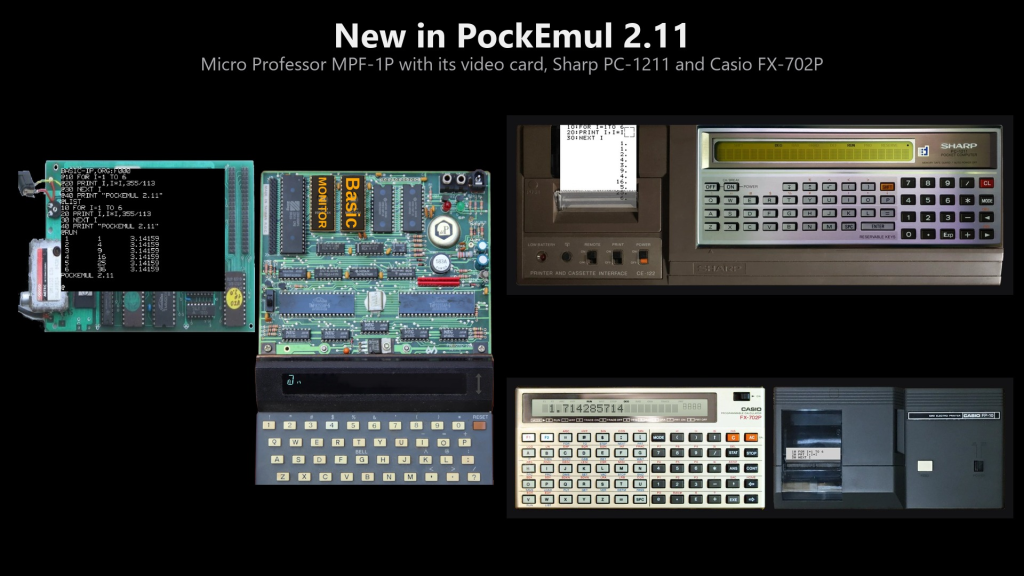
- The Micro Professor MPF-1P arrives, with its video card and its printer.
- The Sharp PC-1211 and the Casio FX-702P, two pioneers of the early 1980s that PockEmul could never emulate the usual way, are now near 100 % rebuilt on a new simulation framework, with the functions, precision and speed of the real machines (within 5 % of a real PC-1211 on 60 timed tests).
- 200 programs are ready to load, the 127 of the PC-1211 Applications Manual and the 73 of Casio’s FX-702P library, and BASIC listings can be imported and exported as text.
For HP and Sharp fans
- The HP-71B and its HP-IL loop are rebuilt device by device: the HP 9114B disc drive, the HP-92198 video interface with its 80 x 24 and 40 x 20 modes, a loop-back cable, and a new device added to the loop in a few taps.
- The HP 82162A thermal printer prints graphics, double width and bar codes.
- Two pockets can be linked straight together by a crossed cable, as Sharp’s EA-129C does: CSAVE on one, CLOAD on the other.
- The CE-140F disk drive is 100 % functional.
- The Sharp PC-1600 gets its timers (WAKE$, ALARM$, ON TIME$), and the National JR-800 its alarm.
Everywhere
- PockEmul gets a new sound system, a smoother emulation speed and about sixty crash fixes.
- On macOS, one universal build runs natively on Apple Silicon; on iOS, .pml files open from Files and AirDrop, and a Restore purchases button arrives.
- Phones and tablets get the display safe area and new dialogs.
- Subscribers get adaptive overclocking, a memory editor, and “Connect a peripheral” from the pocket’s menu.