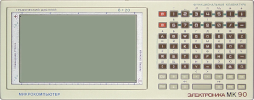
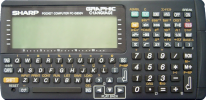
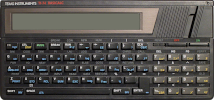
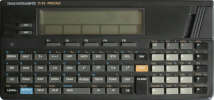
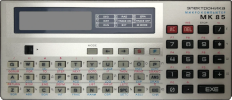
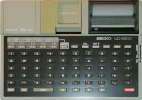
The Elektronika MK-90

( In PockEmul 2.10.0 )

The Elektronika MK‑90 has always been a fascinating machine to me. I’ve long wanted to integrate it into PockEmul because of its unique characteristics that fully justify its place ( a powerful CPU, a large display, … ).
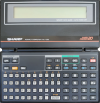
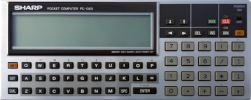
Getting familiar with this computer will be a real challenge for pocket computer enthusiasts, since it uses Russian messages rather than the English interface common to most pocket computers of that era.

The MK‑90 features two extension slots for RAM/ROM modules and a companion device—the MK‑92, a plotter combined with a cassette output (not emulated yet in PockEmul).

Functional Scope

  • CPU
  • Clock chip
  • SMP (RAM/ROM modules)

SMP

The two RAM module slots (saved by battery) are managed directly through the contextual menu using PockEmul’s Disk generic system. This system is gradually being extended to all models that use external modules or storage. It is currently used for:

  • Casio MD‑100 floppy disks
  • HP‑41 raw files
  • MK‑90 SMP modules

LCD Persistence Management

Like many LCDs of that era, the MK‑90’s screen suffers from strong persistence. Developers experimented with simulating multiple shades of gray by rapidly toggling pixels on and off.

I’ve always wanted to emulate this characteristic, seen in other pockets such as the Sharp G850 or Casio Z1. It’s quite complex, and the MK‑90 is the first machine in PockEmul where I attempt to simulate LCD persistence.

The result is far from perfect.
This is because I fully simulate the persistence of each pixel with a depth of 10 states (on/off), tracking how long each pixel has been lit in order to generate a corresponding grayscale level.

While this method is theoretically ideal, the timing of each frame must be absolutely precise to achieve an optimal rendering—and that is not the case.

However, it’s not all bad—under normal use, the realism is greatly enhanced. You truly get the impression of working with the actual machine, complete with its quirks, rather than facing an LCD that looks unrealistically perfect.

The transition between the values on the counter is particularly well rendered.

And here, in slow motion, are the first frames—just to better understand how it works.

Documentation

One major obstacle in integrating the MK‑90 into PockEmul was the lack of accessible documentation. The only available user manuals were in Russian, making discovery nearly impossible for most users.

I began translating the manual into English—a long and tedious task. While searching for a high‑quality PDF, I found Vladislav’s website, where he had retyped the documentation in Russian. So, I asked him if he could share his Word source to ease my translation work.

To my delight, he sent me the already translated English documentation. I warmly thank him, as this documentation was absolutely essential to allow everyone to explore this monument of Russian microcomputing.

Here are the links to his Github space and his web site:
Bs0Dd (Vladislav)
https://mk.bs0dd.net/index.php?lang=eng

The MK‑92 (Not yet released in PockEmul)

I managed to find ROM dump files for the MK‑92 on a forum—huge thanks to the enthusiasts who shared them. This gave me hope of offering the MK‑92 in PockEmul, which would have been a first.

Unfortunately, I still struggle to fully understand its operation. Despite a complete disassembly of its ROM, I was able to isolate the vector character generation for the plotter, but I still don’t understand how the stepper motors are controlled.

As a result, the MK‑92 is not yet enabled in this version of PockEmul ,but I’m still working on it—and believe me, I will succeed!

Perfect emulation is an infinite quest. Please report us any inaccurate behaviour at contact@pockemul.com 

A message for our longstanding users and subscribers :
PockEmul is a 25 years passion project and a labor of love.
We invite you to share the passion and love for vintage computing.
Help us make history like these computers have done in the not-so-distant past.
Help us shape the future of PockEmul. Spread the word!

Leave a Reply

Your email address will not be published. Required fields are marked *